



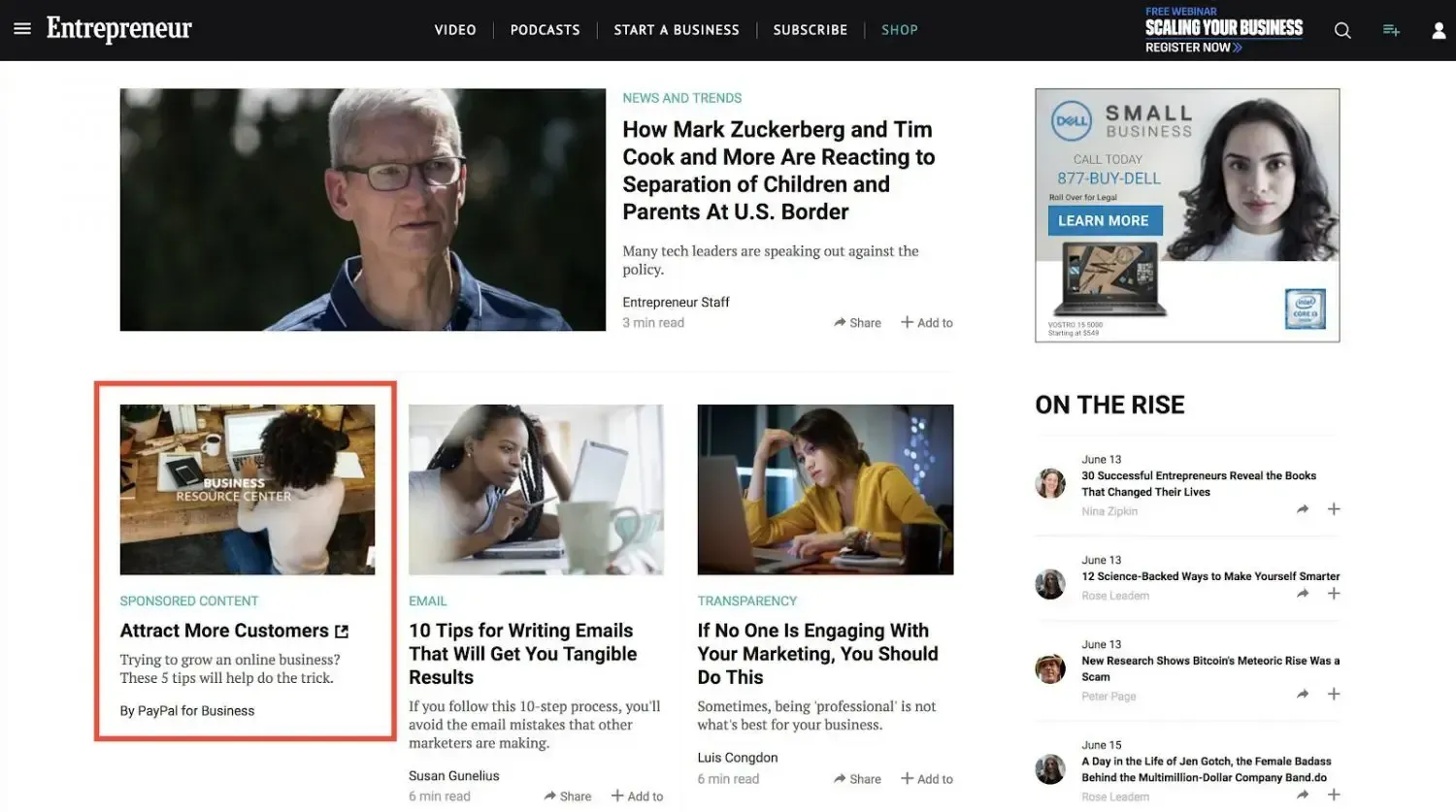
Have you ever noticed how some digital ads seamlessly blend with the other content on the web page, without disrupting the user’s interaction with the page? That’s native advertising, a form of paid advertising, in which the ads match the look, feel, and function of the media format where they appear.
In an era where consumers actively avoid traditional ads, native advertising has emerged as the smart evolution of paid promotion. By blending seamlessly with editorial content, native ads deliver value without disrupting user experience, achieving higher engagement rates and trust levels than banner ads or pop-ups.
How do you spot a Native Ad?
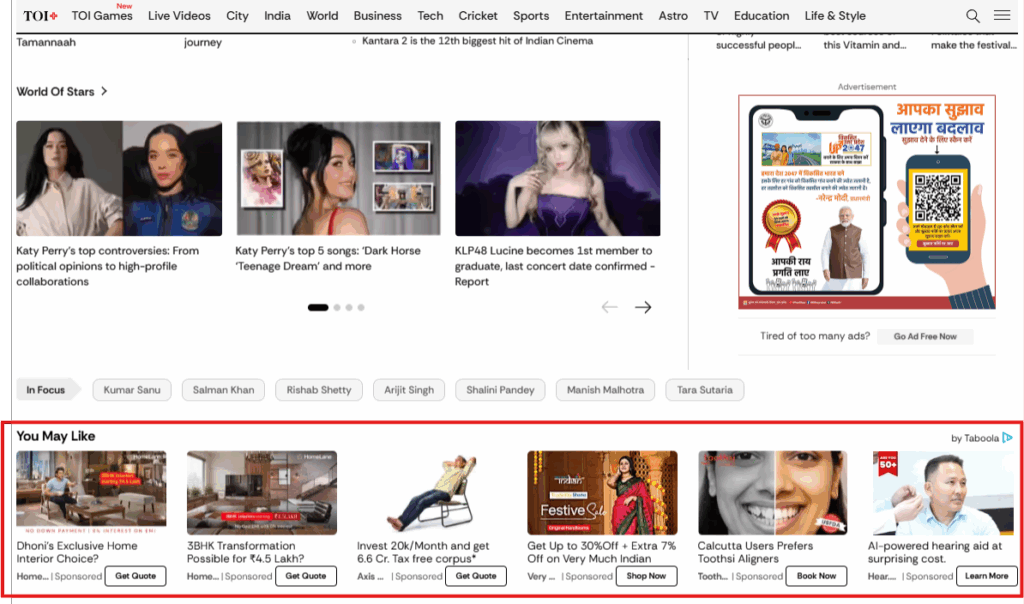
In the example image below, the content highlighted by a red box contains a sponsored ad, whose look and feel matches exactly with the surrounding content. It seems it is a part of the article thumbnails and doesn’t pop up on the face or disturb your view.
Key Characteristics of Native Advertising:
- Seamless Integration – Ads mimic the platform’s organic content style and layout
- Content-First Approach – Focuses on storytelling over hard selling
- Clear Sponsorship Disclosure – Labeled as “Sponsored,” “Promoted,” or “Paid Post” for transparency
- Performance-Driven – Measured by engagement metrics like time spent, shares, and clicks rather than impressions alone
Unlike display ads that interrupt browsing, native advertising enhances the user experience by providing relevant, valuable content that aligns with editorial standards.
How Native Advertising Works?
Native ads leverage contextual relevance and platform-native formats to deliver promotions within familiar content streams:
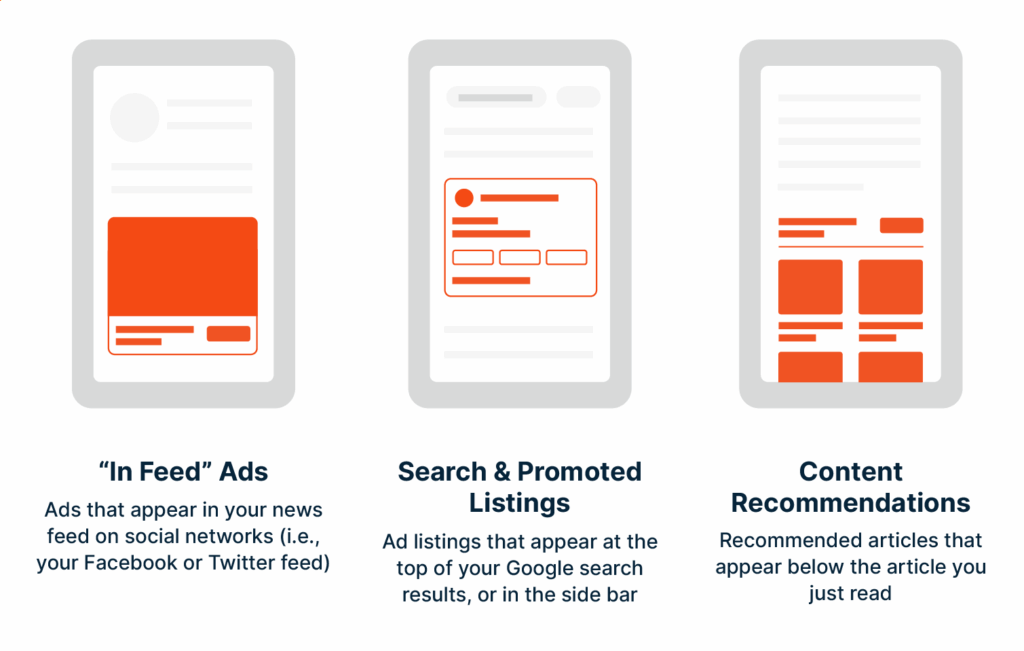
Common Native Ad Formats:
In-Feed Units
These are the most prevalent native ads, appearing as sponsored posts within social media timelines, news feeds, or content streams. They typically include an image, headline, short description, and brand logo, mimicking organic posts. Ideal for mobile-first campaigns, they drive traffic to owned media. Such ads blend into scrolling feeds, achieving 53% more views than banners.
Visual Description: Appears as a regular social media post with a thumbnail image (usually 1:1 or 16:9 ratio), bold headline, short 2-3 line description, brand logo in bottom corner, and “Sponsored” label. Matches the platform’s card-based layout with subtle background styling.
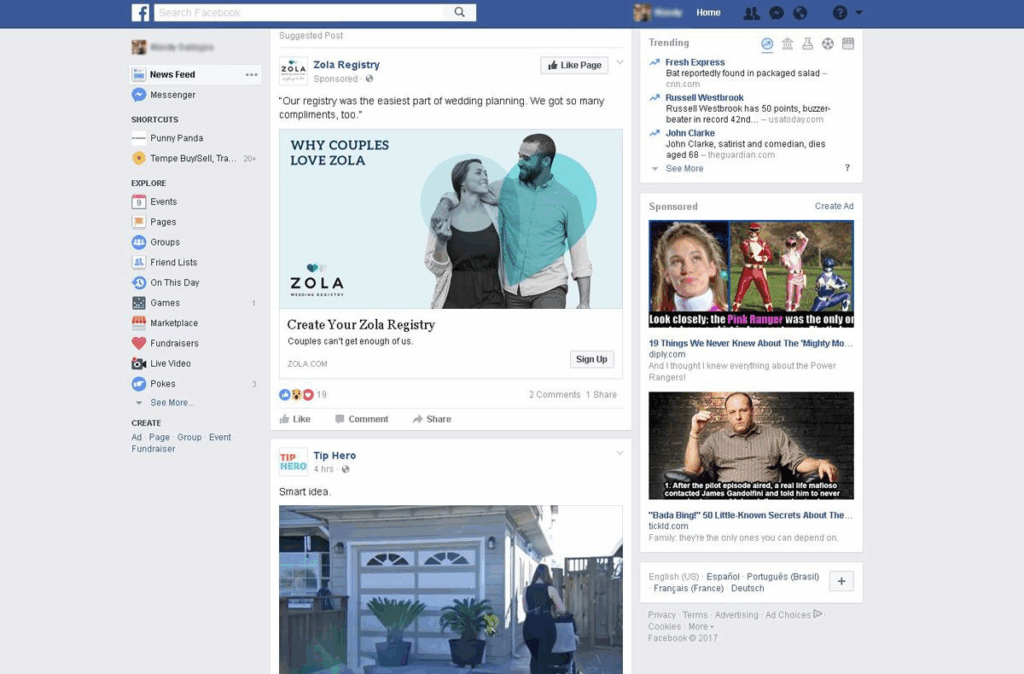
Where to See Examples:
- Facebook/Instagram Feed: Look for “Sponsored” posts with product carousels or lifestyle images blending between organic friend posts
- LinkedIn Feed: Sponsored articles or video posts appearing between professional updates
- Twitter/X Timeline: Promoted tweets with media attachments matching organic tweet styling
Standard Reference: Search “Facebook in-feed native ad example” on Google Images – shows card layouts with blue “Sponsored” badges.
Sponsored Content Articles
Full-length editorial pieces (e.g., articles or videos) branded as “sponsored” on publisher sites like Forbes or WSJ. They match the site’s writing style and layout, often co-created with the publisher for authenticity. Perfect for thought leadership and in-depth storytelling. They can build trust through contextual relevance, boosting purchase intent by 18% over traditional ads.
Visual Description: Full-width article preview with hero image, article-style headline, “Sponsored by [Brand]” badge (often yellow or branded color), and excerpt matching publisher typography. Appears in “Latest News” or “Featured” sections.Where to See Examples:
- Forbes BrandVoice: Visit forbes.com/brandvoice – sponsored articles blend with editorial content
- WSJ Custom Content: Wall Street Journal’s sponsored section shows premium native integration
- HuffPost Promoted Partners: Branded content clearly labeled but stylistically identical to editorial
Standard Reference: Search “Forbes sponsored content example” – shows article cards with prominent sponsorship disclosure.
Promoted Listings
Enhanced search results or recommendation carousels that look like organic listings (e.g., Google Discover or e-commerce “related products”). They include thumbnails, titles, and snippets, appearing in-stream to match page functionality. These types of ads leverage user intent for high click-through rates, especially in discovery feeds.
Visual Description: Full-width article preview with hero image, article-style headline, “Sponsored by [Brand]” badge (often yellow or branded color), and excerpt matching publisher typography. Appears in “Latest News” or “Featured” sections.
Where to See Examples:
- Forbes BrandVoice: Visit forbes.com/brandvoice – sponsored articles blend with editorial content
- WSJ Custom Content: Wall Street Journal’s sponsored section shows premium native integration
- HuffPost Promoted Partners: Branded content clearly labeled but stylistically identical to editorial
Standard Reference: Search “Forbes sponsored content example” – shows article cards with prominent sponsorship disclosure.
Search and Discovery Native Ads
Cards in Google Discover or Apple News with lifestyle images, article headlines, and source attribution. “Sponsored” appears subtly, often matching organic content cards in swipeable feed format.
Visual Description: Enhanced search result cards with star ratings, prices, or badges, appearing after 2-3 organic results. Includes product image, title, snippet, and “Ad” or “Sponsored” indicator in small text matching search engine styling.Where to See Examples:
- Google Shopping Ads: Search any product (e.g., “wireless headphones”) to see sponsored product listings
- Amazon Sponsored Products: Product recommendations marked “Sponsored” in search results
- YouTube Suggested Videos: “Sponsored” video thumbnails in recommendation sidebar
Standard Reference: Search “Google promoted listings native ad” – shows search result page screenshots with ad indicators
Content Recommendation Widgets
“You May Also Like” style units at the end of articles or sidebars, powered by networks like Taboola or Outbrain. They feature headline-image pairs that suggest related (sponsored) content, encouraging further exploration. They capitalize on post-reading curiosity, with strong performance in content distribution.
Visual Description: Grid or list format at bottom of articles with 3-6 thumbnail images (120x90px or 200x150px), sensational headlines, source logo, and “Sponsored” or “Recommended” labels. Often in a light gray background box matching site design.
Where to See Examples:
- Taboola/Outbrain on News Sites: Visit CNN.com or Times of India, scroll to article bottom for “You May Like” widgets
- Right Sidebar Placement: Many blogs show these as vertical stacks with hover effects
- Mobile View: Stacked cards that expand on tap
Standard Reference: Search “Taboola native ad widget” – shows familiar thumbnail + headline combinations.
Native Display Ads
Visually integrated banners or carousels that adopt the site’s design language (e.g., no flashy borders). They can include swipable images or videos, often in apps or websites, and are less intrusive than standard displays. They maintain site aesthetics while delivering interactive elements, ideal for programmatic buys.
Visual Description: Banner-style units without traditional borders, using site fonts/colors. Can be static images, carousels, or video players matching content area styling. “Sponsored” appears as text overlay or small badge.Where to See Examples:
- Washington Post Native Display: Premium publishers show these as integrated content modules
- New York Times T Brand Studio: Custom native units matching editorial design language
- App Native Ads: Within mobile apps, these appear as content cards in scrollable feeds
Standard Reference: Search “native display ad examples IAB” – shows Interactive Advertising Bureau’s standard format illustrations.
The Delivery Process of Native Advertising
- Advertiser creates content optimized for the platform’s audience and format
- Publisher/Ad Network integrates the ad into editorial flow with proper labeling
- Targeting Technology serves ads based on user behavior, interests, and demographics
- Performance Tracking monitors engagement through platform analytics and pixel tracking
Why Native Advertising Outperforms Traditional Ads?
The Ad Block Problem: Over 40% of internet users employ ad blockers, but native ads bypass this resistance by feeling like organic content.
Key Advantages:
- Higher Engagement Rates – Native ads achieve 53% more views and 18% higher click-through rates than traditional display ads (Source: Sharethrough)
- Improved User Experience – Non-intrusive format leads to longer dwell times and lower bounce rates
- Brand Safety – Contextual placement alongside quality content enhances credibility
- Scalability Across Platforms – Works on social media, publishers, apps, and programmatic networks
- Mobile Optimization – Native formats perform exceptionally in mobile-first environments
- Measurable ROI – Track viewability, engagement, and conversions with advanced attribution
Consumer Perception: 70% of users say they want ads that match the site’s content style, making native advertising a win-win for brands and audiences.
Types of Native Advertising Campaigns
1. Sponsored Editorial Content
- Description: Full-length articles or videos created by brands or co-authored with publishers.
- Best For: Thought leadership, product education, and storytelling.
- Examples: Sponsored Forbes articles, WSJ custom content, branded video series on YouTube.
2. Social Native Advertising
- Description: Promoted posts, stories, and reels within social platform algorithms.
- Best For: Brand awareness, community building, and direct response.
- Platforms: Instagram Carousel Ads, LinkedIn Sponsored Content, TikTok TopView.
3. Recommendation Engine Advertising
- Description: “Recommended” content widgets powered by networks like Taboola and Outbrain.
- Best For: Content distribution, traffic generation, and discovery.
- Placement: End-of-article recommendations, sidebar widgets.
4. Search and Discovery Native Ads
- Description: Enhanced listings in search results and content discovery feeds.
- Best For: Intent-based targeting and top-of-funnel awareness.
- Examples: Google Discover, Bing Visual Search sponsored results.
5. Programmatic Native Advertising
- Description: Automated buying of native inventory across multiple publishers.
- Best For: Scale, efficiency, and real-time optimization.
- Technology: DSPs with native capabilities (The Trade Desk, MediaMath).
Best Practices for Effective Native Advertising
Content Creation Strategies
- Solve Problems, Don’t Sell Products – Focus on educational value, industry insights, and customer pain points
- Match Platform Tone – Adapt writing style, visuals, and format to each publisher’s voice
- High-Quality Visuals – Professional photography, infographics, and video thumbnails that entice clicks
- Clear Value Proposition – Answer “What’s in it for me?” within the first few seconds
- SEO Optimization – Incorporate keywords naturally for organic discovery alongside paid promotion
Technical Implementation
- Disclosure Compliance – Follow FTC guidelines with clear “Sponsored” or “Paid” labeling
- Mobile-First Design – Ensure responsive layouts and fast-loading assets
- A/B Testing – Experiment with headlines, images, and CTAs for optimization
- Landing Page Alignment – Seamless transition from ad creative to destination content
- Tracking Setup – Implement UTM parameters, conversion pixels, and viewability measurement
Targeting & Optimization
- Audience Segmentation – Layer demographics, interests, and behaviors for precision
- Lookalike Audiences – Expand reach to users similar to your best customers
- Retargeting Sequences – Multi-touch campaigns across channels for nurturing
- Budget Allocation – Start small, scale winning formats based on engagement data
Native Advertising Platforms & Networks
Publisher Direct
- Premium Publishers: The New York Times, Washington Post, Time Inc. custom studios
- Industry Verticals: Healthcare (WebMD), Finance (Bloomberg), Tech (Wired)
Ad Networks & Tech
- Taboola & Outbrain – Content recommendation specialists
- Revcontent & MGID – Performance-focused native networks
- Sharethrough – Premium native ad exchange
- Programmatic Platforms – Google Display & Video 360, The Trade Desk
Social Platforms
- Meta (Facebook/Instagram) – In-feed sponsored content and Stories
- LinkedIn – B2B thought leadership and company page promotion
- Twitter/X – Promoted Trends and Moment sponsorships
- Pinterest – Promoted Pins and Idea Pins
Challenges & Solutions in Native Advertising
Common Pitfalls
- Overly Salesy Content – Solution: Prioritize education and entertainment value
- Poor Disclosure – Solution: Prominent, compliant labeling builds trust
- Audience Mismatch – Solution: Advanced targeting and lookalike modeling
- Creative Fatigue – Solution: Regular A/B testing and seasonal refreshes
- Measurement Gaps – Solution: Cross-platform attribution and viewability tools
Regulatory Considerations
- FTC Guidelines – Clear and conspicuous sponsorship disclosure
- COPPA Compliance – Age-appropriate content for child-directed advertising
- GDPR & CCPA – Consent management for European and California users
- Platform Policies – Adhere to each network’s content and targeting rules
Conclusion
Native advertising represents the evolution of digital marketing in an ad-saturated, privacy-conscious world. By prioritizing seamless integration, authentic storytelling, and user-centric value, native ads don’t just survive—they thrive where traditional advertising fails. They bridge the gap between editorial excellence and commercial objectives, delivering higher engagement, better ROI, and genuine brand affinity.
Leave a Reply