



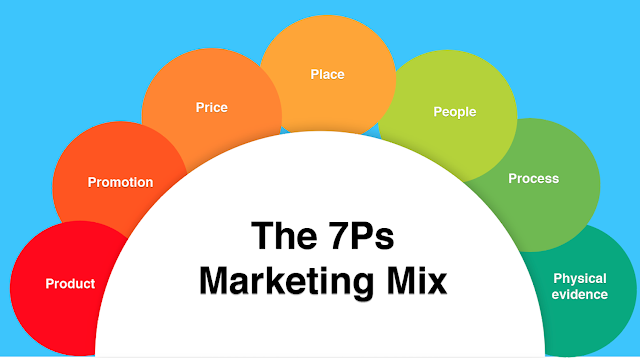
The 4Ps were designed at a time when businesses were more likely to sell products, rather than services and the role of customer service in helping brand development wasn’t so well known. Over time, Booms and Pitner added three extended ‘service mix Ps’: Participants, Physical evidence and Processes, and later Participants was renamed People. Today, it’s recommended that the full 7Ps of the marketing mix be considered when reviewing competitive strategies.
The 7Ps helps companies to review and define key issues that affect the marketing of their products and services, and is often now referred to as the 7Ps framework for the digital marketing mix.
Using the Internet to Vary the Marketing Mix
| Product | Promotion | Price | Place | People | Process | Physical Evidence |
| Quality | Marketing Communications | Positioning | Trade Channels | Individuals on Marketing Activities | Customer Focus | Sales/Staff Contact Experience of Brand |
| Image | Personal Promotion | List | Sales Support | Individuals on Customer Contact | Business-Led | Product Packaging |
| Branding | Sales Promotion | Discounts | Channel Number | Recruitment | IT-Supported | Online Experience |
| Features | Public Relation | Credit | Segmented Channels | Culture/Image | Design Features | |
| Variants | Branding | Payment Methods | Training and Skills | Research and Development | ||
| Mix | Direct Marketing | Free or Value-Added Elements | Remuneration | |||
| Support | ||||||
| Customer Service | ||||||
| Use Occasion | ||||||
| Availibility | ||||||
| Warranties |
How can you use this model?
Although it’s sometimes viewed as dated, we believe the 4Ps are an essential strategy tool to select their scope and is particularly useful for small businesses. For startups reviewing price and revenue models today, using the Business Model Canvas for marketing strategy is a great alternative since it gives you a good structure to follow.
Companies can also use the 7Ps model to set objectives, conduct a SWOT analysis and undertake competitive analysis. It’s a practical framework to evaluate an existing business and work through appropriate approaches, whilst evaluating the mix element as shown below, and ask yourself the following questions:
- Products/Services: How can you develop your products or services?
- Prices/Fees: How can we change our pricing model?
- Place/Access: What new distribution options are there for customers to experience our product, e.g. online, in-store, mobile, etc.
- Promotion: How can we add to or substitute the combination within paid, owned and earned media channels?
- Physical Evidence: How do we reassure our customers, e.g. impressive buildings, well-trained staff, great website?
- People: Who are our people, and are there skills gaps?
- Partners: Are we seeking new partners and managing existing partners well?
An example of a company using the 7Ps strategy
Take a look at HubSpot as an example, which was founded in 2006; HubSpot has 8,000+ customers in 56 countries and sells software. What does their marketing mix look like?
This is a top-level overview; you would take this into greater detail and ask the following questions:
- Products/Services: Integrated toolset for SEO, blogging, social media, website, email and lead intelligence tools.
- Prices/Fees: Subscription-based monthly, Software-As-Service model based on the number of contacts in the database and the number of users of the service.
- Place/Access: Online! Network of Partners, Country User Groups.
- Promotion: Directors speak at events, webinars, useful guides that are amplified by SEO and effective with SEO. PPC Social media advertising, e.g. LinkedIn.
- Physical Evidence: Consistent branding across communications.
- Processes: More sales staff are now involved in conversion.
- People: Investment in online services.
- Partners: Hubspot looks to form partnerships with major media companies such as Facebook and Google, plus local partners, including Smart Insights which it is collaborating on research in Europe.
Rotimatic is an example of premium pricing. Price skimming is a pricing strategy that comes into play in any of the following cases:
- Many products in the same category
- The product is in its declining stage in the lifecycle
- To target price-sensitive TG.
There could be other reasons, and you can do deep research to understand the pricing strategies adopted by firms.


Leave a Reply